

We often assume the over-the-counter (OTC) aisle is safe simply because the boxes don’t require a doctor's signature.
That is a dangerous assumption for older adults.
Last time, we walked through the cold and flu aisle and discussed how decongestants spike blood pressure and cough syrups trigger sudden confusion. Today, we are moving one shelf over.
In this week’s video, I review five common OTC medications that can trigger acute kidney failure, steal your parent’s memory, or completely prevent other prescriptions from working. Number 5 might surprise you.
1. Ibuprofen and The “Triple Whammy”
For younger bodies, reaching for ibuprofen or naproxen is often the first instinct. But here is what happens inside an 80-year-old body.
First, filtering speed in aging kidneys drops by fifty percent. Second, ibuprofen blocks production of prostaglandin - that hold the arteries to the kidneys open. When your parent takes an NSAID, it physically squeezes those arteries. If they are even slightly dehydrated, blood flow to the kidneys drops to a trickle.
If your parent takes a standard blood pressure pill (an ACE inhibitor or ARB) and a water pill (a diuretic) for edema, adding ibuprofen creates a catastrophic drug interaction known as the “Triple Whammy” Loboz & Shenfield, Med J Aust 2005. It halts blood flow and causes acute kidney failure, sending thousands of seniors to the emergency room every year.
It also strips the stomach lining, creating silently bleeding ulcers that lead to profound fatigue and severe anemia.
2. The 14-Year Heartburn Pill (Prilosec / Nexium)
The purple box clearly states it should only be taken for fourteen days. Yet, millions of older adults end up taking proton-pump inhibitors (PPIs) for fourteen years.
Many vital nutrients—specifically Vitamin B-12, iron, and calcium—require stomach acid to be properly absorbed into the bloodstream. When you chemically shut down stomach acid for years, you stop or slow down absorption of these nutrients (Lam et al., JAMA 2013). Over time, this malabsorption leads to irreversible nerve damage, balance problems, osteoporosis, and devastating hip fractures.
3. The “P-M” pain meds and Benadryl memory problems
If you see the letters “P-M” on a pain reliever or sleep aid bottle, put it back on the shelf.

The “P-M” ingredient is almost always diphenhydramine. That is the exact chemical found in Benadryl.
In a 30-year-old, diphenhydramine causes mild drowsiness. In an 80-year-old body, it stays in the brain for days, actively blocking acetylcholine. Acetylcholine is the major neurotransmitter your brain requires for memory, attention, and reasoning. These drugs are actively suppressing their cognitive clarity, doubling the risk of falls, and accelerating delirium (Gray et al., JAMA Intern Med 2015).
4. Vitamins, Minerals, and Antacids with Certain Medications
Minerals act like chemical magnets in the digestive tract.
If your parent takes a thyroid medication (like levothyroxine) or a specific antibiotic (like Cipro) and washes it down with a calcium antacid or a multivitamin, the minerals bind directly to the drug. They fuse together into an insoluble calcium rock. The medication passes right through their system without ever being absorbed. Biologically, they didn’t get a single dose.
Furthermore, aging kidneys struggle to flush out excess magnesium from OTC antacids, leading to toxic buildup that can trigger dangerous heart rhythms.
This is easily spotted by a pharmacist during a Brown Bag Review.
Fewer Pills, More Paws is now an Audiobook!
The essential guide to safely navigating a healthcare system designed to add medications is now available as an audiobook!

Look what the phenomenal narrator of Fewer Pills, More Paws: Caring for Your Aging Parents and Lessons from Our Pets, Justin Straight, has to say.
This is a great crash course into the industry while also giving you fantastic pet-based anecdotes along with real, pragmatic steps when the time comes for your aging parents. Wonderful read!
– Justin Straight, Narrator
He’s the narrator, so you know he’s read it! (Thank you, Justin!) Get your copy from ProAudioVoices today. The audiobook will be available on other platforms in the near future.
5. “Natural” does not mean safe
Supplements like Ginkgo Biloba, high-dose Vitamin E, and St. John’s Wort carry potent pharmacological effects, this also means potent side effects.
If your parent is on a prescription blood thinner, like warfarin or eliquis, adding Ginkgo or Vitamin E disables their blood platelets, drastically increasing their risk of internal hemorrhage.
Even worse, the body interprets the plant alkaloids in supplements like St. John’s Wort as a potential poison. To protect us, the liver ramps up the production of detoxifying enzymes to break it down—a process called enzyme induction (Markowitz et al., JAMA 2003). But these enzyme don’t just break down plant alkaloids, they also break down prescription drugs. Except now, the liver works so fast at breaking down prescription medications that they no longer work. Production of these enzymes takes 2-4 weeks, so about a month after starting the herbal supplement, the body could go into dangerous withdrawal.
Even more dangerous, those withdrawal effects get interpreted as side effects to the herbal rather than a drug interactions that took a month to show up.
The Pharmacist’s Action Plan
So how do you protect your parent at the pharmacy?
Buy Single-Ingredient Products: Stay away from multi-symptom formulas. If your parents needs a pain relieve like Tylenol, skip the Tylenol-PM and just get Tylenol (or the generic, that’s just as good). The “PM” part is big trouble. If they have a cough, treat the cough. Do not subject their liver, bodies, and brains to three extra chemicals they do not need.
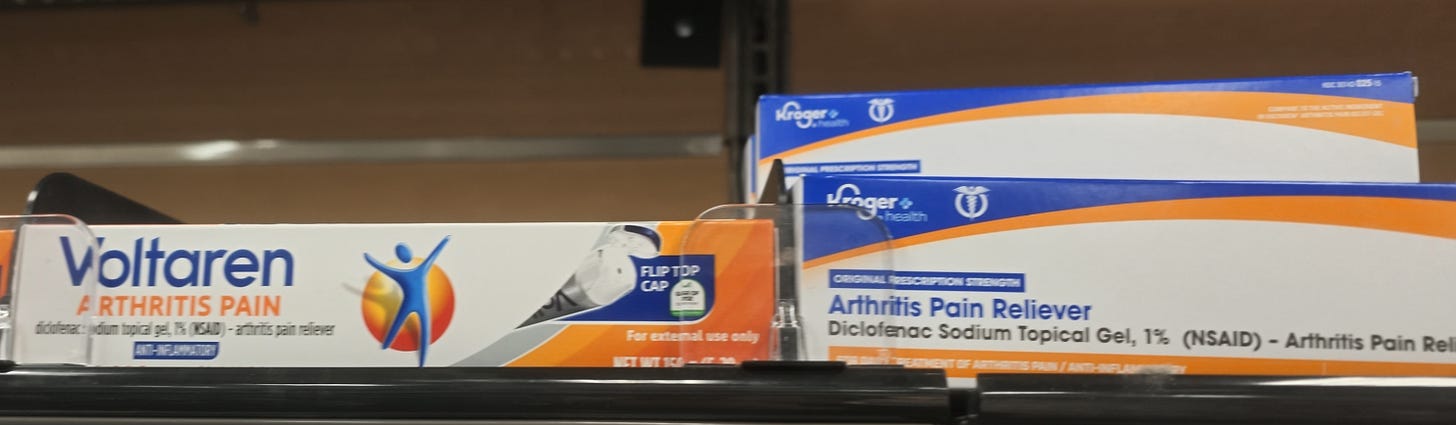
Instead of ibuprofen: For joint pain, look for Voltaren gel. It relieves localized pain topically without entering the systemic bloodstream and destroying their kidneys.
Call your Pharmacist for a Brown Bag Review: Dump every prescription, OTC pill, and herbal supplement onto the kitchen counter, put them in a bag, and take them to your local pharmacist. A clinical pharmacist can review the entire list and spot the dangerous interactions, look for red flags, and prescribing cascades that the computer system missed.

You do not have to navigate this medication maze blindly.
Download the free MyRxPro Caregiver’s Toolkit today to access our Master Medication List and audit their medicine cabinet this weekend.
Watch the video now:
Then, if you still have question, give us a call for a free consultation to figure out if we can help you. No obligation. We love hearing from you! 📞❤️
Keep advocating. And let’s keep them safe—one pill at a time.
Peace and wellness,
David Lee, PharmD, PhD, Lead Pharmacist & Founder of MyRxPro