

An 82-year-old woman—let’s call her Margaret—lives independently in her own home. She waters her garden, pays her bills, and manages her daily routine.
Sixty days later, she sits in a wheelchair in a nursing home, chemically sedated, while her $380,000 family home is listed for sale to reimburse the facility for her bed.
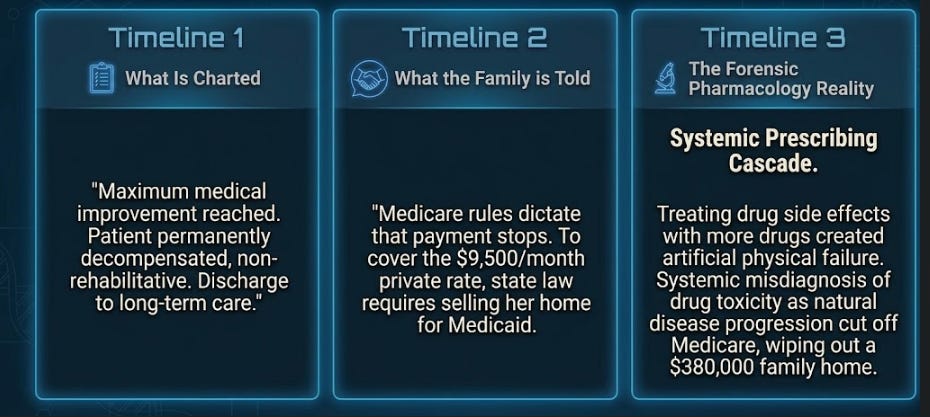
If you read her official medical record, you will see a story of unavoidable age-related frailty. If you speak to her care team, you will hear a compassionate story about a family coming to terms with cognitive decline. But if you analyze the biochemical evidence, you uncover a completely different reality.
To understand what actually happened to Margaret, we have to apply forensic pharmacology.
What Is Forensic Pharmacology?
Forensic pharmacology is the science of reconstructing clinical events to establish how drug interactions, drug concentration, and prescribing errors cause physical or cognitive harms. For example falls and delirium.
While general medicine focuses on prescribing drugs to treat symptoms, forensic pharmacology investigates the aftermath: auditing dosages, liver and kidney clearance rates, receptor site competition, and neurochemical cascades to determine whether an injury was caused by disease or by medication toxicity. It translates complex molecular science into a timeline of cause and effect that families and clinicians can clearly understand.
When applied to geriatric care, forensic pharmacology exposes the vast gap between what medicine assumes it’s doing and the biological reality inside an aging body. Traditional medicine assumes most ailments are due to aging, but the pharmacology and timeline shows something different.
Watch the video now to get the whole story:
Homeostenosis: Homeostasis in Older Ages
Before tracing the three timelines, we must understand the biology.
Homeostasis is the process of keeping your body in a physiologic buffer zone of hydration, electrolytes, temperature, pH, etc. Medications work by modifying some homeostasis process, for example, a blood pressure pill may increase how much sodium your body excretes, thereby reducing the amount of water in your body and reducing the blood pressure.
An 80-year-old body operates under homeostenosis—the progressive narrowing of physiological reserve. The homeostenosis that Margaret is experiencing makes her sensitive to the effects of medications.
The homeostasis of a 30-year-old’s body is a wide platform to stumble on; the homeostenosis of an 80-year-old‘s body is on a tightrope. Livers clear drugs slower, kidneys filter less, and the blood-brain barrier becomes far more permeable. The margins for error vanishe; small side effects can become big problems.
When a healthcare system treats an aging body with heavy-handed prescribing, that narrow buffer collapses.
The Three Parallel Timelines
We are going to follow three timelines. First is what the medical system charts. Second is what the family hears from the medical team. Third is what the forensic pharmacology says. We will trace the disconnect between what the medical system assumes about dementia and delirium. And, you’ll also see what the evidence, timeline, and clinical pharmacology really shows.
The Fall at home (Day 0)
What the family experiences: Mom was fine on Tuesday. She was out in her yard watering the roses, tracking her bills at the kitchen table, and making plans for the weekend. On Thursday, she caught a ticklish cold. She mentioned her chest felt a little tight from coughing, so she walked down to the grocery store aisle to pick up some cough syrup and a nighttime sleep aid. At 2:15 AM, my phone rang. The paramedics said she was on the living room floor, unable to stand. When I rushed to her house, I saw the empty tea cup, the cough syrup on the nightstand, and her throw rug shifted slightly on the hardwood. My first thought was, 'She tripped in the dark. Her memory is slipping, her legs are getting wobbly, and she shouldn't be living alone anymore.
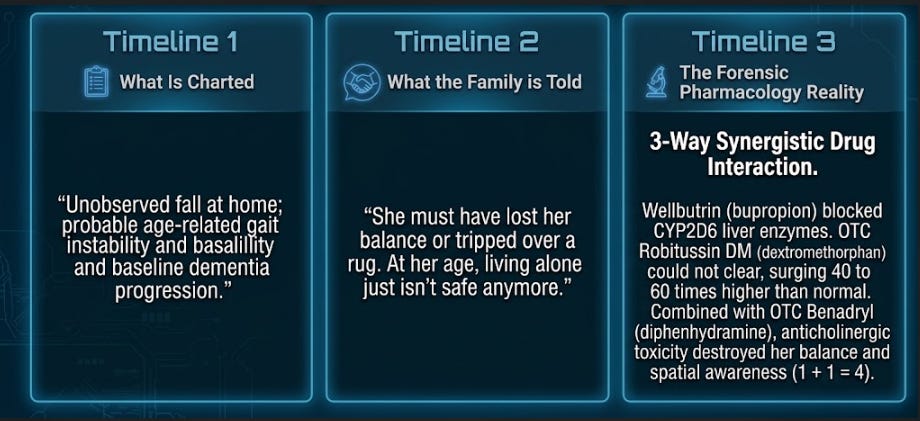
The Forensic Pharmacology Reality: Margaret did not fall because she was 82. She fell because two over-the-counter bottles created an acute pharmacological collision.
The nighttime sleep aid contained diphenhydramine (a potent first-generation antihistamine), and the cough syrup contained dextromethorphan and alcohol. In an aging body operating under homeostenosis, diphenhydramine crosses the blood-brain barrier rapidly. It acts as an aggressive anticholinergic, directly blocking acetylcholine—the exact neurotransmitter the brain requires to process spatial orientation, maintain balance, and encode memory (Gray et al., JAMA Intern Med 2015).
At the same time, diphenhydramine exhibits off-target alpha-1 adrenergic receptor blockade, which directly clashes with the 10% alcohol solvent in the cough syrup. When Margaret stood up in the dark at 2:00 AM to use the bathroom, her autonomic nervous system could not constrict her blood vessels to maintain cerebral blood flow. Her blood pressure plummeted—a severe orthostatic collapse (American Geriatrics Society Beers Criteria Update Expert Panel, J Am Geriatr Soc 2023).
Combined with the central sedative effects of dextromethorphan, Margaret was walking a biological tightrope in a chemical hurricane (Leipzig et al., J Am Geriatr Soc 1999). Her brain was disoriented, her vision was blurred, and her motor reflexes were blunted. Her legs did not give out from “old age”—her central nervous system was chemically stunned before her foot ever touched the hardwood floor.
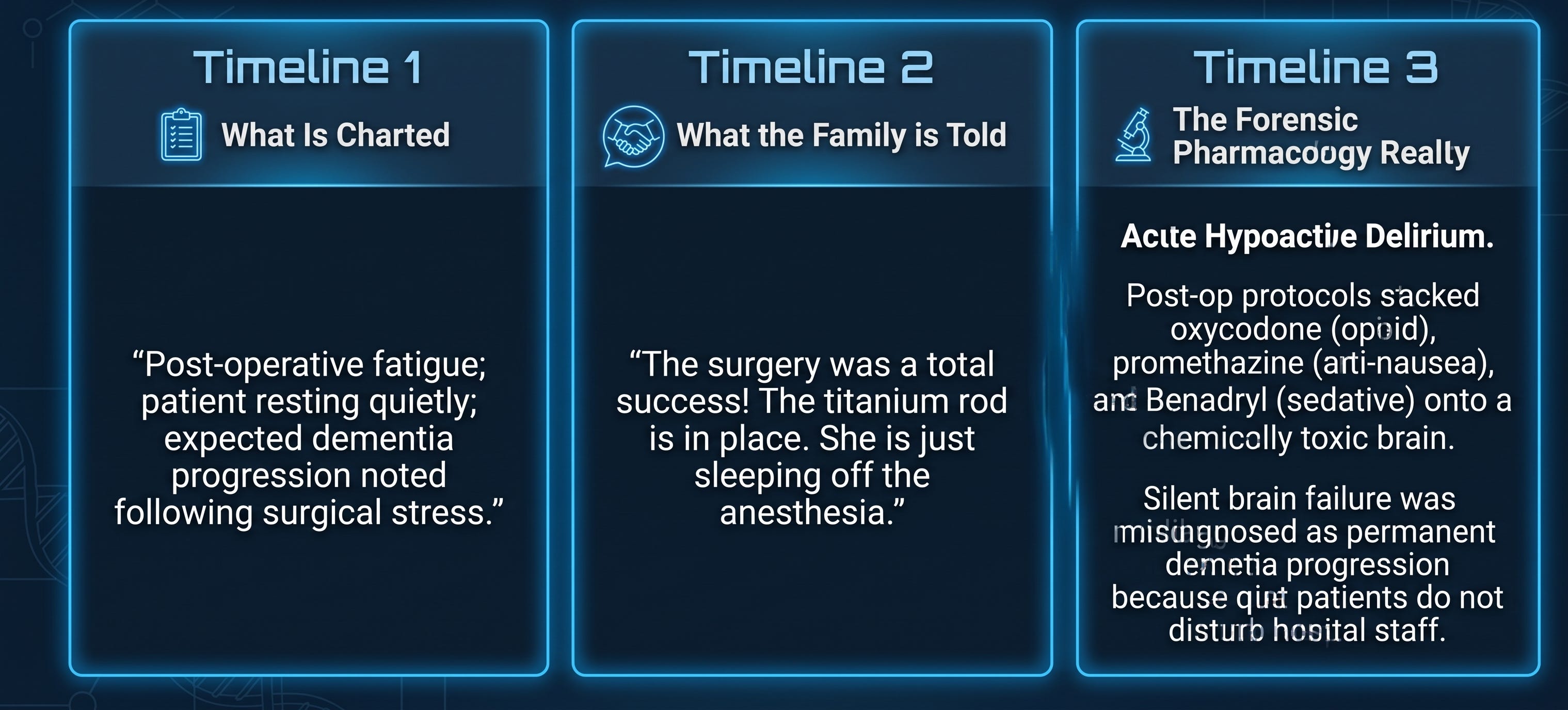
What the family experiences: We spent sixteen hours in the emergency room waiting area before they moved her to a room. The orthopedic surgeon walked out after two hours in the operating room, smiled, and said, 'The hardware is in. We put in a titanium rod, and mechanically, the operation was a complete success.' But when I went into the post-op recovery room, Mom wasn't there. She was staring blankly at the ceiling, barely whispering, and sleeping eighteen hours a day. When I tried to talk to her about her garden, her eyes rolled back. The resident doctor patted my shoulder and said, 'Surgery is violent on an eighty-two-year-old body. She’s resting off the anesthesia, but the stress of trauma often causes underlying dementia to suddenly surface.
The Forensic Pharmacology Reality: Inside her brain, a second disaster occurred. Post-op hospital protocols stacked oxycodone (an opioid painkiller), promethazine (an anti-nausea drug), and diphenhydramine (for hospital sleep) directly onto a brain already suffering from drug toxicity. This chemical overload triggered hypoactive delirium—acute, sudden-onset brain failure. Unlike hyperactive delirium (where a patient shouts or pulls at IV lines), hypoactive delirium is silent. Margaret sat motionless, staring at the wall, sleeping 18 hours a day. Over 60% of hypoactive delirium cases are completely missed by hospital teams because quiet patients do not disturb the floor. The medical team mistook acute, reversible drug toxicity for permanent dementia progression.
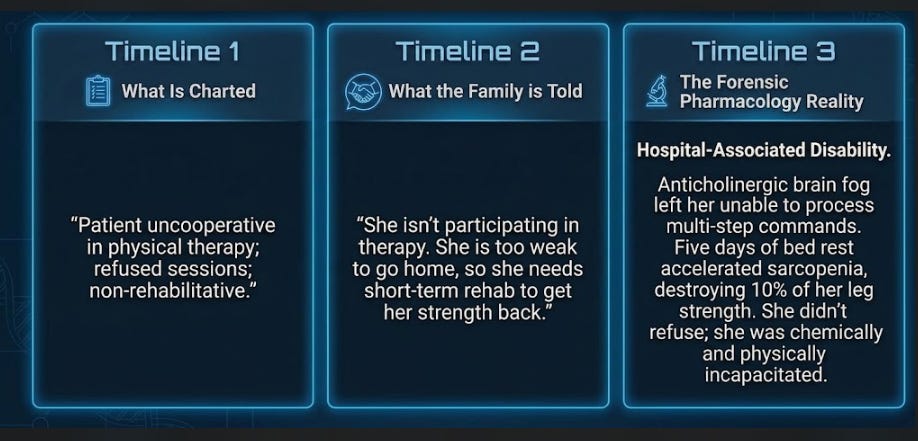
What the family experiences: On Day 5, the physical therapist came into her hospital room for fifteen minutes. I watched from the visitor chair as he tried to help her sit up on the edge of the bed. Mom couldn't hold her head up. Her eyes were unfocused, and she couldn't follow his instructions to push off the mattress. The therapist signed his tablet, turned to me, and said, 'She’s just not cooperating today.' An hour later, the hospital discharge planner called me into the hallway. She told me the hospital needed her bed for an incoming emergency patient, and because Mom failed her physical therapy benchmarks, she was too weak to go home. She said, 'We are discharging her to a Skilled Nursing Facility for short-term rehab so she can get her strength back.' I felt relieved, thinking rehab was just a temporary pit stop to get her back on her feet.
The Forensic Pharmacology Reality: Margaret didn’t refuse therapy; her brain was in an anticholinergic fog, leaving her physically unable to process multi-step commands. While she lay immobile, her body suffered from functional decline caused by Hospital-Associated Disability. In older adults, age-related muscle loss (sarcopenia) is accelerated exponentially by bed rest. An 80-year-old forced into complete bed rest loses up to 2% of total skeletal muscle mass per day.
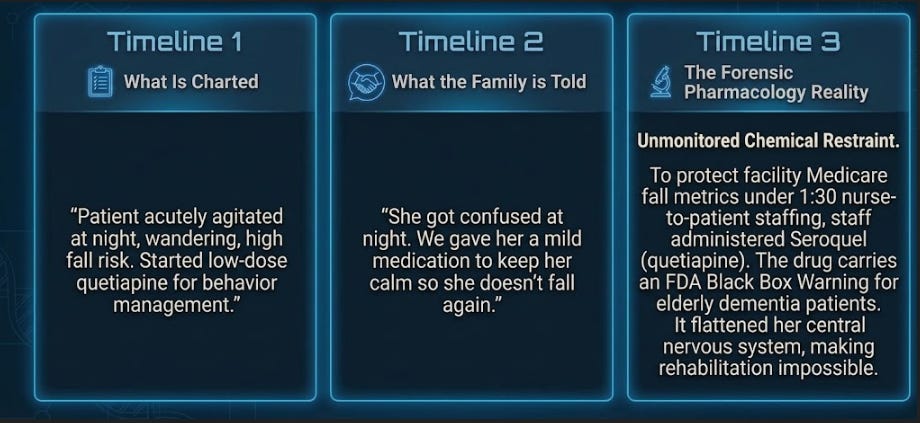
What the family experiences: I walked into the nursing home at 10:00 AM on a Tuesday expecting to see Mom doing her exercises in the therapy gym. Instead, I found her sitting in a wheelchair in the hallway, slumped over to the side, drooling onto her sweater. Her eyes were completely glassy. I ran to the nurse’s station, and the nurse on duty checked her chart and said, 'She had a rough night around 11:30 PM. She got confused, didn't recognize her room, and tried to climb out of bed to find the bathroom. She was a major fall risk, so the covering provider ordered a mild medication to keep her calm so she doesn't break her other hip.' I sat next to Mom, held her cold hand, and felt a wave of guilt. I thought, 'She's getting so aggressive and confused. The dementia is taking over, and she's becoming too hard for anyone to manage.
The Forensic Pharmacology Reality: At 11:30 PM, her drug-induced delirium flared in an unfamiliar room. An understaffed facility (where one nurse manages 30 or 40 residents) used a chemical restraint to protect their Medicare fall metrics. The covering provider ordered Seroquel (quetiapine), an atypical antipsychotic. This medication carries an explicit FDA Black Box Warning stating that antipsychotics increase the risk of stroke, accelerated cognitive decline, and death when given to elderly patients with dementia. Quetiapine flattened her central nervous system activity. Sedated day and night, she sat slumped in a wheelchair, unable to participate in morning physical therapy.
What the family experiences: On Day 45, the facility administrator called my brother and me into a windowless conference room. She slid an official paper across the table: a Notice of Medicare Non-Coverage. She explained that because Mom hadn't shown 'measurable improvement' in physical therapy over the last two weeks, Medicare was legally cutting off payment for her stay. The private-pay rate to keep her in that bed was $9,500 a month. Mom's modest savings account was wiped out in less than ninety days. That’s when the administrator gently explained Medicaid. She told us, 'To qualify for government help, state law mandates a complete asset spend-down. She can only keep $2,000.' Then she dropped the real bomb: Mom's house—the home our father built, where we grew up, the home she paid off dollar by dollar—had to be put on the market immediately. I signed the real estate papers with shaking hands, convinced that this was just the heartbreaking, inevitable financial cost of growing old.
The Forensic Pharmacology Reality: An unmonitored prescribing cascade—treating drug side effects with more drugs —chemically sedated a functional adult, causing her from participating. Because the healthcare system mistook medication toxicity for natural disease progression, Medicare cut off payment. Under Medicaid spend-down rules, her home was listed for $380,000, and forty years of family equity was funneled directly into an escrow account to reimburse the facility while she sat in a wheelchair, chemically sedated.
How Caregivers Can Interrupt the Cascade
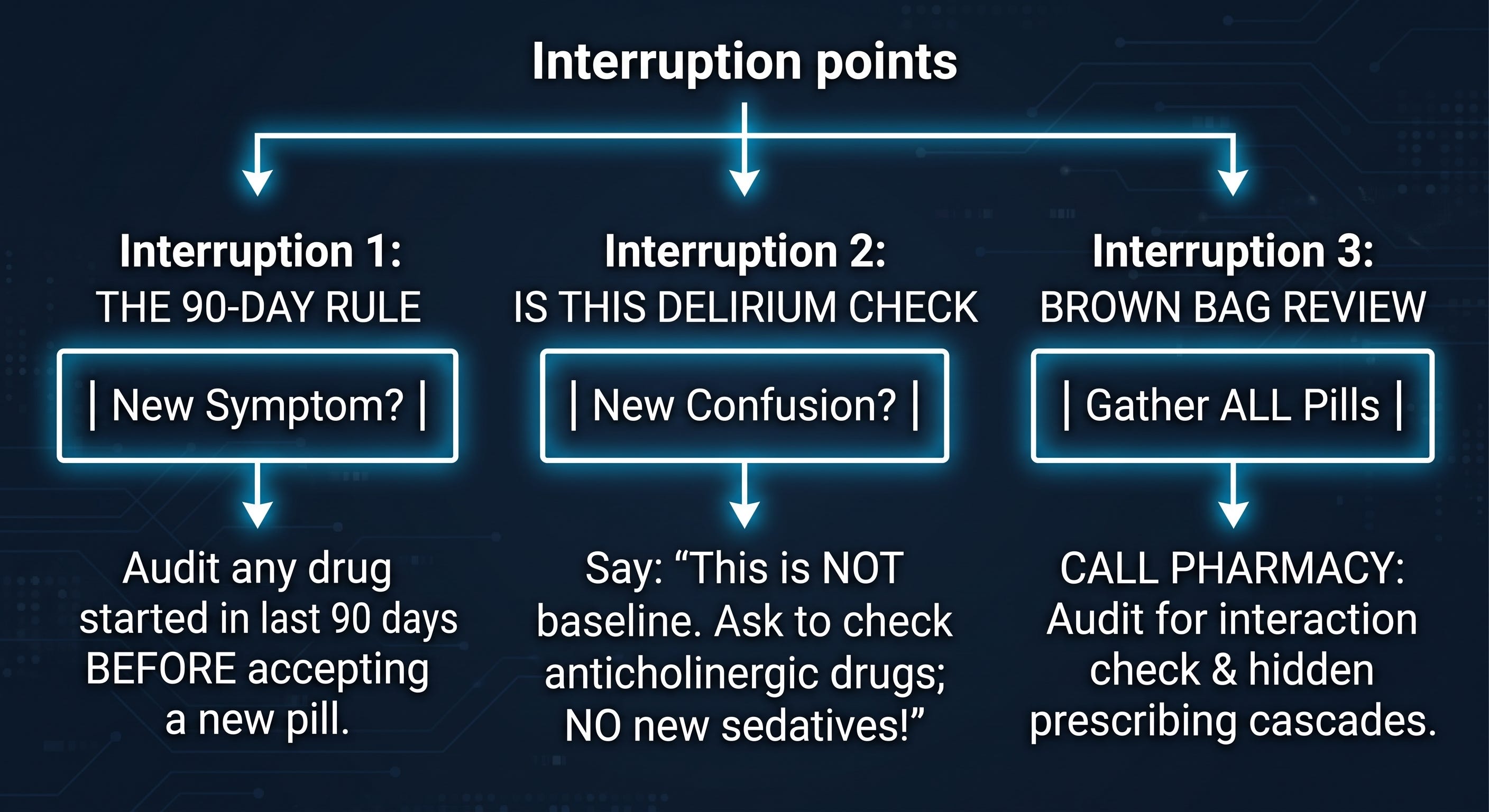
There are 3 interruption points that could have prevented this from happening.
Interruption point 1. The 90-Day Rule for New Symptoms
Whenever an aging parent develops a new physical or cognitive symptom—dizziness, a fall, sudden confusion, or gait changes—do not assume it is aging. Any symptom appearing within 90 days of starting a new medication or changing a dose must be evaluated as a drug reaction until proven otherwise. Before accepting Pill #2 to treat the symptom, demand an audit to potentially remove Pill #1.
Interruption point 2. The “Not Baseline” Delirium Check
If your parent is hospitalized and becomes suddenly quiet, lethargic, or confused, do not let medical staff write it off as dementia progression. Tell the medical staff,
“This is not my parent’s baseline. On Tuesday, they were completely alert and independent. I believe this is acute hypoactive delirium. I want an immediate review of their medications to calculate their anticholinergic burden, and I do not want any sedatives or psychotropic drugs added.”
Interruption point 3. The Brown Bag Review
If your parent sees multiple specialists, they are likely caught in polypharmacy—medication overload. Electronic health record systems used by different clinics do not talk to each other in real time, and pharmacy software frequently misses three-drug interactions.
Gather every prescription bottle, over-the-counter syrup, eye drop, and supplement into a paper bag. Take it to a clinical pharmacist for a full review.
Watching for your parent’s safety doesn’t take a medical degree, it takes recognizing where you can interrupt the system for safety.
Want to see this in action? Watch the video here:
Want a Forensic Analysis of Your Own?
I work with families one-on-one to halt the chaos. I don’t sell pills, and I don’t take insurance kickbacks.
This is The Science of Caregiving: identifying hidden drug interactions, halting the prescribing cascade, and lifting the chemical fog before it triggers a midnight fall or a catastrophic hospital admission combined with compassion.
The modern medical system is optimized for speed—adding another pill in an eight-minute visit. We optimize for your parent’s cognitive clarity, dignity, and independence. Don’t wait for an emergency room crisis to find out what those medications are doing. By then, it could already be too late to get your parent back.
Schedule Your 1-on-1 Forensic Analysis at
MyRxPro.com/consultations
Fewer Pills, More Paws is now an Audiobook!
The essential guide to safely navigating a healthcare system designed to add medications is now available as an audiobook!

Look what the phenomenal narrator of Fewer Pills, More Paws: Caring for Your Aging Parents and Lessons from Our Pets, Justin Straight, has to say.
This is a great crash course into the industry while also giving you fantastic pet-based anecdotes along with real, pragmatic steps when the time comes for your aging parents. Wonderful read!
– Justin Straight, Narrator
He’s the narrator, so you know he’s read it! (Thank you, Justin!) Get your copy from ProAudioVoices today. The audiobook will be available on other platforms in the near future.
Keep advocating and keeping them safe.
Peace and wellness,
David Lee, PharmD, PhD
MyRxPro