

Have you ever walked into your aging parent’s kitchen, looked at the counter, and just stared at the mountain of pill bottles?
You catch yourself wondering: How on earth did it get this bad?
The honest answer is that nobody set out with the goal of overmedicating your parent. But the modern healthcare system isn’t broken by mistake—it is optimized for speed and extraction. A cardiologist, a neurologist, and a urologist each look at one single organ through a keyhole. They prescribe a targeted drug for their specific area, but nobody stands back to look at the whole picture.
Medical training is obsessed with when to start a medication. There are almost zero protocols for when to stop one.
This week’s video we discuss how to protect your parent today.
The Tightrope Walker in a Hurricane
To protect your parent, you have to stop thinking of an 80-year-old body as a broken machine. It is a Stradivarius violin—a vintage masterpiece with decades of resilience, but incredibly delicate.
Crafted by Antonio Stradivari in Italy around 1700, a Stradivarius violin is widely considered the finest musical instrument ever built—irreplaceable, priceless, and worth upwards of $15 million today. Modern science still cannot replicate its unique acoustic resonance.
It is not a broken wooden box; it is a temperamental, vintage masterpiece that has grown extraordinarily sensitive to every subtle change in its environment. That is an aging body. It isn’t failing—it has simply entered a state of higher sensitivity that requires a master’s touch rather than another heavy-handed prescription.

In geriatrics, we call this homeostenosis. When you are 30, your body walks on a wide, stable platform. But by 80, that platform narrows down to a tightrope. If you stack a dozen medications on top of that, it’s like watching a tightrope walker in a hurricane.
An aging kidney’s filtration rate drops by 30% to 50%. Liver blood flow slows way down. This means standard adult doses linger in the body, stacking up until a “normal” dose accidentally becomes a toxic overdose.
The Domino Effect: The Prescribing Cascade
This narrowed tightrope is where the prescribing cascade begins. It is a dangerous domino effect.
Drug A causes a hidden side effect. The doctor misdiagnoses that side effect as a new disease and prescribes Drug B. Then Drug B causes its own side effect, leading to Drug C. Before you know it, your parent is taking six different drugs just to treat the side effects of the first one.
The Jury-Ready Translation: Here is the single most important question you can ever ask at an 8-minute doctor’s appointment: “Could this new symptom actually be a side effect of a medication they’re already taking?”
Meds That Stealing Their Memory
If you audit your parent’s medicine cabinet today, look out for nighttime sleep aids and “PM” formulas. These rely on anticholinergic drugs like diphenhydramine or doxylamine.
Your parent’s brain relies on a chemical called acetylcholine for memory and sharp thinking. These over-the-counter sleep aids cross right into the brain and actively block that chemical. They are literally stealing their memory, causing acute confusion, brain fog, and a massive fall risk that can linger for 48 hours.
Deprescribing and The Master Conductor
The system won’t fix this for you. You must provide the questions, observation, and the whole picture.
Be the Conductor: Remind the doctors your parent is a delicate, vintage masterpiece that is prone to environmental changes - including medications. Side effects are not “just getting old,” it’s a serious medical problem that create real dangers. Gather every single prescription, OTC pill, and supplement. Put them in a bag and take them to a community pharmacist for a “Brown Bag Review.”
Function Over Numbers: Deprescribing is the clinical process of safely tapering off unnecessary pills. Ask the doctor to prioritize how your parent functions every day over hitting a magic number on a lab chart.
The Leo Framework: Just the cat Leo in my book, Fewer Pills, More Paws, who communicates pain through subtle shifts in behavior, you must treat your parent’s sudden confusion or agitation as clinical data. Sudden changes are rarely just “dementia getting worse”—they are usually physical pain, an unrecognized infection, or medication toxicity.
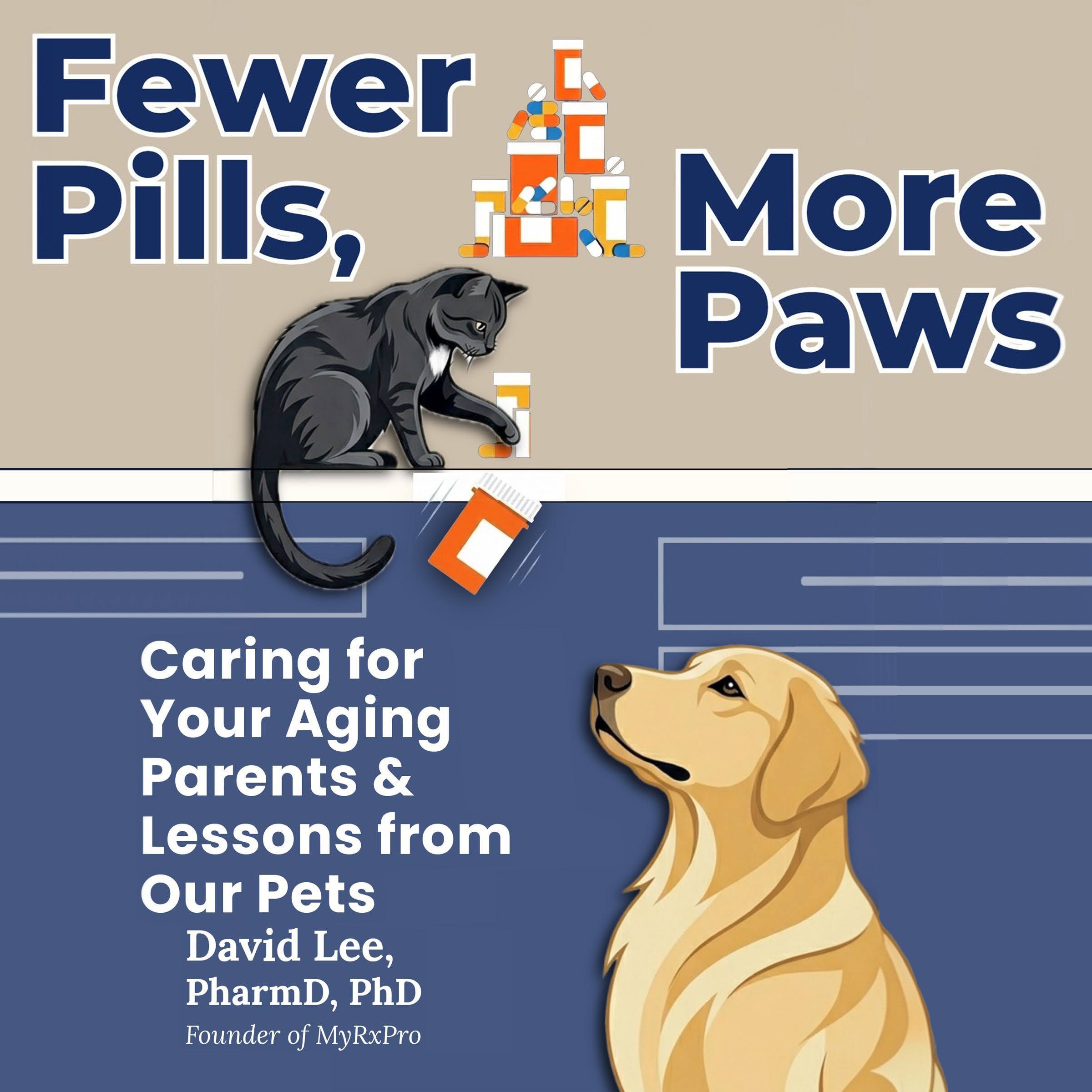
Fewer Pills, More Paws: Caring for Your Aging Parents and Lessons from Our Pets, is now available as an Audiobook!
The Bottom Line When we slow down, pay attention, and use less medication, we give our parents their lives back.
Watch the video now:
Peace and wellness,
David Lee, PharmD, PhD, Lead Pharmacist, MyRxPro
The Audiobook is Here!
After months of anticipation, the audiobook has arrived and I could not be happier! The narrators Justin Straight did a phenomenal job! Check it out at AMPlify Audiobooks. Soon to be available through other audiobook platforms.
Want the full picture? Fewer Pills, More Paws: Caring for Your Aging Parents and Lessons from Our Pets is your personal guide book to protecting your parent, and yourself. In a healthcare system designed to add pills, learn to defend yourself from overmedication, oversedations, and prioritize quality of life.

Want to hear an interview about the audiobook with ProAudioVoices’s podcast AudioBook Connection? Listen here:

Or wherever you get your podcasts: