

I just posted a video on YouTube titled The Enshittification of Nursing Homes. If you don’t know what enshittification is, it was popularized by tech writer Cory Doctorow about how tech applications start off great, something that is of value to the consumers. Later, when the investors demand to be paid, ads appear. When that isn’t enough, they stop investing in what made the tech great. The service declines. But by that time they have cornered the market and you have no choices. Think Google, Facebook, Twitter before ads dominated those platforms.
Did you know the same thing has quietly been happening to nursing homes all across the country?
What’s been happening to nursing homes
Private equity firms have quietly acquired thousands of nursing homes across the country using a predatory financial scheme known as the OpCo/PropCo model. By splitting a facility on paper into a Property Company (the landlord) and an Operating Company (the care staff), corporate investors charge exorbitant, inflated rent to siphon away hidden profits. To survive these artificial costs, facilities are forced into severe nursing home understaffing. The result goes far beyond cold food or unanswered call lights—it leads to unwashed residents, undetected UTIs exploding into acute delirium, and overwhelmed nurses resorting to heavy chemical restraints like Quetiapine (Seroquel) just to survive their shifts. Research shows this corporate extraction model directly increases resident mortality by 10%. The issue isn't a lack of compassionate caregivers; it’s that private equity ownership in healthcare has systematically re-engineered nursing home care to prioritize investor profit over human life.
Fight Now For Your Future
While you were watching, you’re probably thinking about the facility your parent is in or one you might be considering. You might be thinking about the staffing you’ve noticed. The medication errors. The falls.
But I want you to think about something else too.
One day, you might be the one in that facility.
That might sound dramatic. But it’s true. Most of us will need nursing home care at some point. And if you don’t fight now to change the system, the system you’re in 20 or 30 years will be even worse than what your parent is experiencing today.
This isn’t just about saving your parent’s life right now.
It’s about saving your own future.
So now that you’ve watched the video, I’m going to show you what you can do about it, right now.
Federal Legislation: The Take Back Our Hospitals Act
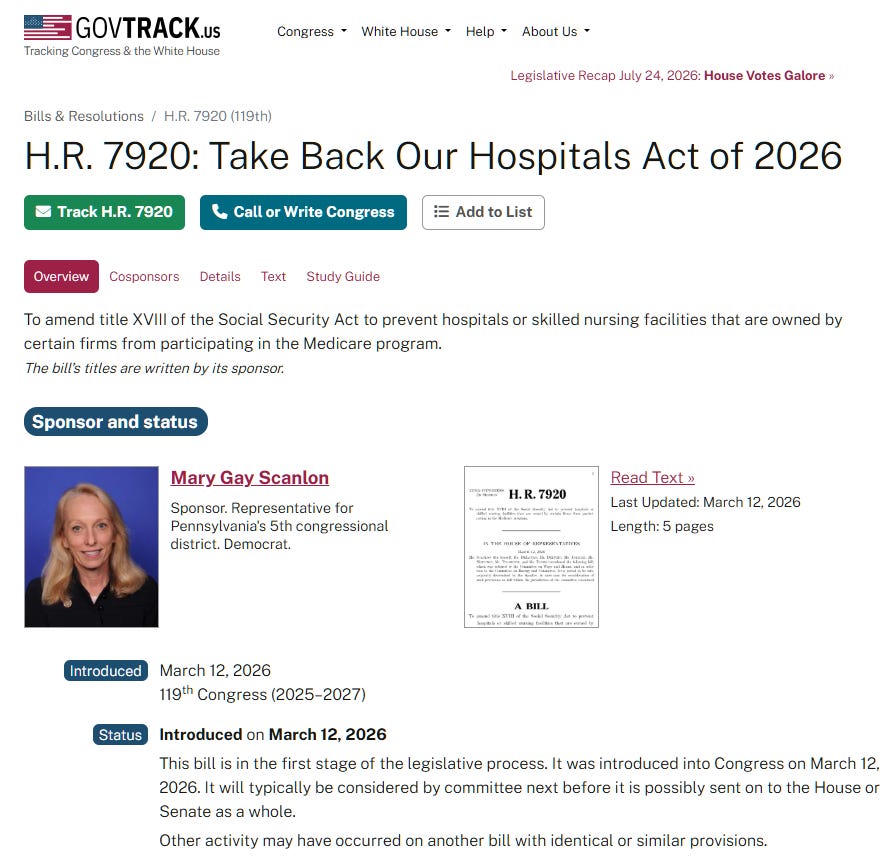
In March 2026, U.S. Senator Chris Murphy (D-CT) and U.S. Representative Mary Gay Scanlon (D-PA) introduced the Take Back Our Hospitals Act.
Here’s what it does:
It would ban private equity firms from owning nursing homes and hospitals that receive Medicare funding.
This is the biggest legislative push against private equity in healthcare we’ve seen. And it’s gaining momentum. My own Senator Jeff Merkley (D-OR) and others have joined in support.
What you can do:
Find your representatives: Go to Congress.gov and search for your district. Find out who your Senator and House Representative are.
Contact them directly:
Senate: Find your senator’s contact info at senate.gov
House: Find your representative at house.gov
What to say: “I support the Take Back Our Hospitals Act because private equity ownership is destroying nursing home care in my community. I want you to co-sponsor this bill.”
That’s it. Legislators track constituent support on specific bills.
Follow the bill: Track S. 4085 (Senate) / H.R. 7920 (House) on GovTrack.us — you’ll can sign up to get updates on its progress.
Federal Legislation: Nursing Home Staffing Standards
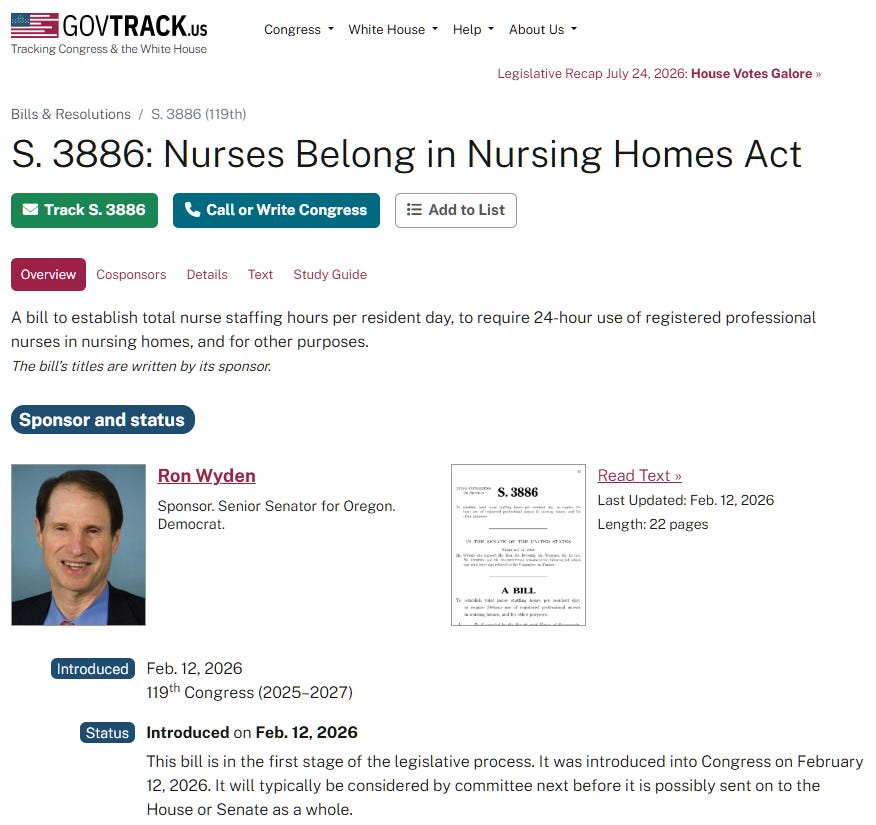
In February 2026, My other Senator, Ron Wyden (D-OR), introduced the Nurses Belong in Nursing Homes Act.
What it does: Establishes mandatory nurse-to-patient staffing ratios in nursing homes nationwide.
The ratios would be:
1 registered nurse per 8 residents (daytime)
1 registered nurse per 12 residents (nighttime)
Certified nursing assistants and nursing staff appropriately scaled
Why this matters: Staffing ratios directly prevent the medication errors, infections, falls, and over-medication we talked about in the video.
What you can do:
Contact your Senator using the same process above
Say: “I support the Nurses Belong in Nursing Homes Act because my parent’s facility is dangerously understaffed. Nurse-to-patient ratios will prevent harm.”
State-Level Action
States are moving faster than Congress.
The Private Equity Stakeholder Project tracks state legislation. As of March 2026, 79 bills across 25 states are addressing private equity in healthcare.
Connecticut (predictably, given Senator Murphy’s leadership) has been most aggressive:
Passed (2025): Law requiring nursing homes to publicly disclose OpCo/PropCo ownership structures and rent amounts
Passed (2026): Multiple bills limiting private equity’s profit extraction methods
What similar bills look like:
Transparency requirements (who owns it, how much rent is paid)
Restrictions on related-party transactions
Minimum staffing ratios
Limits on dividend payments to parent companies
What you can do:
Check what your state is doing: Visit Private Equity Stakeholder Project and click on your state to see what bills are pending
Find your state representatives:
National Conference of State Legislatures (helps you find state legislature contact info)
Your state’s legislature website (Google “[Your State] legislature contact”)
Contact them: “I want you to support legislation requiring disclosure of nursing home ownership structures and limiting OpCo/PropCo profit extraction.”
Attend hearings: State health committees often hold hearings on healthcare bills. These are public. Show up. Tell your story.
CMS Complaint Portal
Here’s something you can do right now, for your parent’s specific facility:
The Centers for Medicare & Medicaid Services (CMS) has a complaint portal where you can report staffing issues, medication errors, and safety violations.
What to report:
Medications not administered on time
Falls and injuries
Lack of care/hygiene
Unexplained behavioral changes in your parent
Any incident that suggests understaffing
How to file a complaint:
Go to Medicare.gov
Search for your parent’s facility by name
Click “Report a Concern” at the bottom of the facility’s page
Fill out the complaint form with specific dates and incidents
Why this matters: CMS uses complaint data to:
Investigate the facility
Issue citations (which affect their Star Rating)
Potentially revoke Medicare funding if violations are serious enough
One complaint can trigger an inspection.
Multiple complaints from families create a pattern that CMS takes seriously.
Advocacy Organizations Doing This Work
You don’t have to do this alone. These organizations are actively fighting private equity in healthcare and need supporter participation:
Private Equity Stakeholder Project — Tracks legislation, provides research, helps families understand what’s happening. Their state legislative tracker is invaluable.
American Federation of Labor and Congress of Industrial Organizations (AFL-CIO)
Our Financial Security — Consumer advocacy group fighting private equity abuses across sectors, including healthcare
Media Pressure
Investigative journalists are starting to cover private equity in nursing homes. There is a lot of outrage about this and more coverage is only increasing pressure.
If your facility is part of a larger problem:
Contact your local news station’s investigations unit — tell them your story
Document everything — take photos (if allowed), keep records, save all emails and incident reports
Connect with other families — collective stories are more powerful than individual complaints
Recent investigations that led to change:
Multiple ProPublica investigations on private equity hospital chains
NBC News: Senate Investigation Exposes Prospect Medical Hospital Chain (January 2025)
Boston Globe: Rhode Island Hospitals Unite Against Private Equity Takeover (2024-2025)
What You Can Do
This week:
Find out if your parent’s facility is OpCo/PropCo
File a CMS complaint if you’ve observed staffing-related issues
Contact your U.S. Senator and Representative about the Take Back Our Hospitals Act
This month:
Check your state legislature’s website for pending healthcare bills
Contact your state representatives about staffing ratio legislation
Join the Private Equity Stakeholder Project’s mailing list for updates
Ongoing:
Document all staffing issues (dates, times, what happened)
Report patterns to CMS
Share your story with local media if appropriate
The Bottom Line
The predatory OpCo/PropCo model isn't just an abstract corporate structure—it shows up directly in your parent’s daily care. If you are noticing sudden changes or feeling like something is wrong, you aren't imagining things.
Families across the country often search for answers when they notice these critical signs of nursing home neglect and overmedication:
Sudden Lethargy & Behavioral Changes: If you suspect signs of overmedication in your elderly parent—such as slurred speech, heavy sedation, or a new prescription for Seroquel (quetiapine) for dementia agitation—the facility may be using chemical restraints to keep residents quiet during understaffed shifts.
Frequent Falls & Physical Red Flags: Unexplained bruises or falls in a nursing home may not be “accidents.” They are often the direct result of delayed care and violations of nurse-to-resident staffing ratios.
Rapid Cognitive Decline: Sudden confusion, delirium, or aggression in an elderly parent is often triggered by an untreated Urinary Tract Infection (UTI) or missed medication doses that went unnoticed for days by overwhelmed staff.
Basic Hygiene & Care Failures: Seeing a parent left in a dirty diaper, unwashed for days, or dealing with ignored call lights for hours are major warning signs of systemic understaffing.
What You Can Do Right Now
The OpCo/PropCo extraction model only works if families stay silent and assume these issues are “just part of aging.” They aren’t.
Document Everything: Keep a detailed log of late medication doses, ignored call lights, and staff names.
File an Official Report: Learn how to file a CMS complaint against a nursing home on Medicare.gov to trigger an independent state inspection.
Demand Accountability: Reach out to your state representatives, back mandatory staffing ratio legislation, and speak up.
The moment you document, file a complaint, and demand answers, you break the cycle. Don’t stay silent—your voice breaks the inertia.
Need Help For Your Parent Right Now?
Systemic change takes time, but your parent needs safe care today.
If you are looking for tools you can use now, download our free MyRxPro Caregivers Toolkit for the very tools I use to help families.
If you need help coming up with a strategy for your parent’s nursing home, I work one-on-one with families in these exact situations. Whether you are dealing with unexplained cognitive changes, medication concerns, or navigating facility accountability, you don’t have to figure it out alone.
Want to Understand the Full Picture?
I wrote Fewer Pills, More Paws to help families navigate the broken systems they’re up against. It includes the full toolkit for advocating for your parent’s care—from medication documentation to understanding your rights.

Available now:
📖 eBook
Peace and wellness,
David Lee, PharmD, PhD, lead pharmacist at MyRxPro
PS: I’m planning on covering other ways enshittification has been happening in healthcare. Leave me a comment about what other areas you’d like me to cover.
Key Resources
Congress.gov — Find your representatives
Senate.gov — Contact your Senator
House.gov — Find your Representative
Private Equity Stakeholder Project — State legislative tracker
CMS Nursing Home Compare — File complaints
GovTrack.us — Track federal bills
NCSL Find Your Legislature — Find state reps